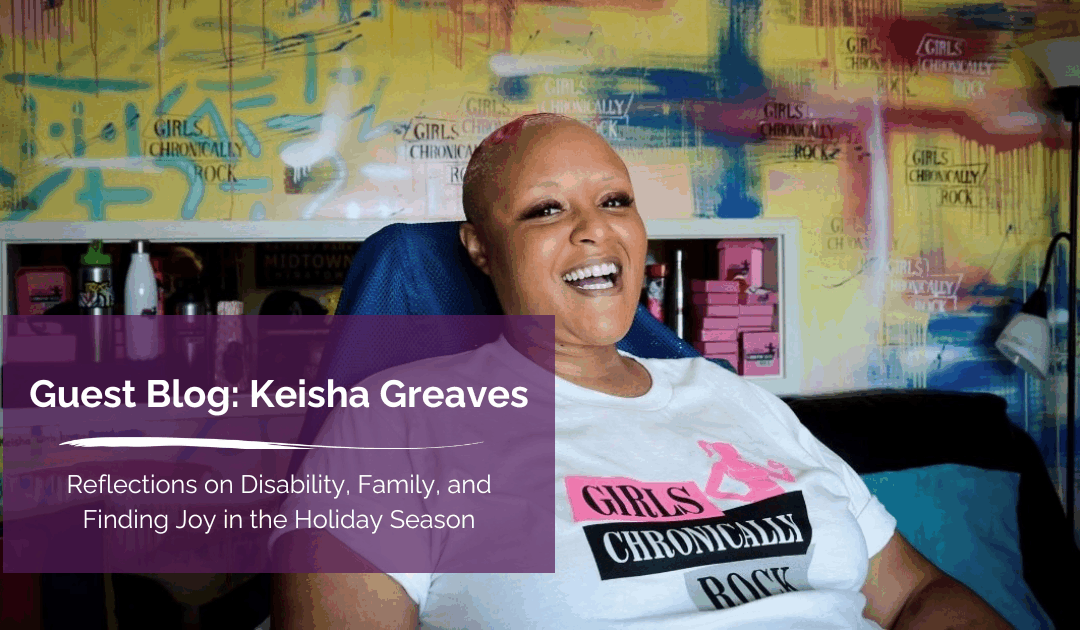
By Keisha Greaves
Greaves is the founder of Girls Chronically Rock, an adaptive fashion consultant, and a self-advocate.
The holidays are supposed to be the most wonderful time of the year, right? The lights, the family gatherings, the smell of home-cooked food, and the excitement that seems to float through the air.
But as someone living with a disability, I’ve learned that the holiday season often comes with a complicated mix of emotions, joy, love, frustration, and sometimes loneliness all at once.
Every year, as the decorations start going up and people rush to plan dinners or book flights, I find myself reflecting on what the holidays really mean to me, and what they mean to so many in the disability community.
The Emotional Weight of the Season
The holidays can bring up a lot of feelings, especially when you live with a disability. There’s this pressure to be cheerful, to go to every event, to smile for the family photos, even when your body or mind is exhausted.
I love the idea of celebrating with the people I care about, but there’s always this little voice in my head wondering: Will this year be accessible? Will I feel seen? Will people understand what I need? It’s not about wanting special treatment, it’s about wanting to be included without feeling like a burden.
Sometimes I see people on social media posting pictures of big family dinners or holiday trips, and I can’t help but feel a mix of emotions. Happiness for them, yes, but also sadness. Because not everyone gets to experience that version of the holidays. Some of us are at home, with limited help, trying to navigate the season the best way we can. Some of us are missing loved ones. Some are managing pain or fatigue while trying to keep the spirit alive. And that’s something people don’t always talk about.
Family, Caregiving, and Complicated Dynamics
Family can be both a blessing and a challenge around the holidays. For many in the disability community, the holidays mean juggling caregiving schedules, managing transportation, and making sure our needs are met, all while trying not to feel like we’re “too much.”
When you rely on caregivers or PCAs, the holidays can add another layer of stress. People take time off, schedules shift, and routines that keep you stable suddenly get interrupted. That can be scary. Because for some of us, having consistent help isn’t just a comfort, it’s a necessity.
There have been times when I’ve had to rearrange my entire week because my PCA was away for the holidays. While others are relaxing, I’m making calls, coordinating backup, and hoping things run smoothly. And while I’m grateful for those who show up for me, I can’t ignore the fact that it’s hard sometimes.
Then there’s family. Some relatives are incredibly supportive, while others still don’t fully “get it.” They might not understand why I can’t come upstairs to join everyone in the living room or why certain foods are difficult to manage. They don’t see the energy it takes to simply show up, to be present and social when your body feels heavy.
But through all of that, I remind myself that family isn’t always about blood, it’s about connection, understanding, and love. And I’ve learned to build my own version of “family” that includes people who see me, value me, and make the holidays a little easier to navigate.
The Accessibility Reality
Let’s talk about accessibility, because that’s one of the biggest challenges during the holiday season. Whether it’s a family gathering at someone’s house with stairs and narrow doorways, or a restaurant that claims to be “ADA compliant” but somehow forgot to think about bathroom space, accessibility can make or break the holiday experience.
It’s wild that, in 2025, so many places still don’t prioritize accessibility. I can’t tell you how many times I’ve been excited to go out for a holiday meal or celebration, only to realize the space doesn’t work for my wheelchair. It’s embarrassing and frustrating when you’re told, “Oh, we didn’t think about that.” Moments like that can make you feel invisible, like you’re not part of the picture people had in mind.
That’s why I’ve learned to advocate, to ask questions in advance, to call ahead. I’ve learned that my comfort and safety matter, and that accessibility is not a favor, it’s a right. But emotionally, it still stings sometimes. Especially when accessibility issues mean missing out on something special. While everyone else is upstairs dancing, laughing, and taking pictures, I’m thinking, “Why couldn’t this space be built for all of us?”
Loneliness and the Unspoken Feelings
The truth is, the holidays can be lonely, even when you’re surrounded by people. There’s a certain kind of isolation that comes from being in a room full of loved ones who don’t fully understand your day-to-day reality.
There are moments when you smile through the conversation, laugh at the jokes, and pretend you’re not in pain or exhausted, just to keep the energy up. You don’t want to dampen the mood, but inside you’re wishing people could see the invisible effort it takes to simply be there.
And for some in the disability community, loneliness comes from physical isolation, when transportation, caregiving, or health issues keep us from seeing friends and family at all. Not everyone has the luxury of visiting loved ones or going out during the holidays. That’s why I think it’s so important to check in on people, especially those with disabilities. Sometimes, a phone call, a FaceTime, or a small gesture can make all the difference.
Redefining Joy
Despite the challenges, I still love the holidays. I really do. I love the sparkle, the spirit, and the sense of hope that fills the air. But I’ve had to redefine what joy looks like for me.
It’s not always about the big gatherings or picture-perfect moments. It’s about the small things, the quiet mornings watching holiday movies, the smell of something good cooking in the kitchen, the laughter with a close friend, or the feeling of gratitude that comes from making it through another year.
Joy, for me, is also about reflection. It’s about recognizing how far I’ve come, the resilience it takes to navigate this life with strength, humor, and grace. It’s about giving myself permission to rest, to say no, and to celebrate in ways that truly feel good to me.
Finding Community
One thing I’ve learned through my work and connections in the disability community is that so many of us share these same emotions, even if our stories are different. We talk about the same accessibility barriers, the same family dynamics, the same feelings of being seen and unseen all at once.
But we also share incredible resilience. We’ve built community through support, advocacy, and creativity. We find ways to make the holidays accessible, whether that means hosting at our own homes, doing virtual hangouts, or creating our own new traditions that honor our needs and our joy.
There’s a unique bond that forms when you meet others who just get it. People who understand that celebrating the holidays with a disability takes preparation, patience, and emotional strength, but also that it can be deeply meaningful when done on your own terms.
What I Hope for This Season
This year, I’m choosing to focus on gratitude, not the kind that ignores the hard parts, but the kind that embraces them. I’m grateful for the people who show up consistently. For the caregivers who work through the holidays. For the friends who check in. For the accessible spaces that do exist and make life a little easier.
I hope that as a society, we continue to grow in awareness. That families and friends learn to ask: “What do you need?” That businesses start thinking about accessibility as part of the holiday spirit. And that we remember inclusion isn’t just about ramps, it’s about respect, empathy, and making sure everyone feels welcome. Because the holidays should belong to all of us.
Closing Thoughts
For anyone reading this who’s struggling this holiday season, please know you’re not alone. Whether you’re feeling isolated, facing accessibility barriers, or just trying to hold it all together, your feelings are valid. Celebrate your way. Rest when you need to. Ask for help without guilt. And remember that you are part of a community that understands you, values you, and celebrates you, not just during the holidays, but every single day.
As for me, I’ll be wrapping myself in gratitude, finding joy in the little things, and reminding myself that even when the world feels a bit too loud or too inaccessible, I still belong here.