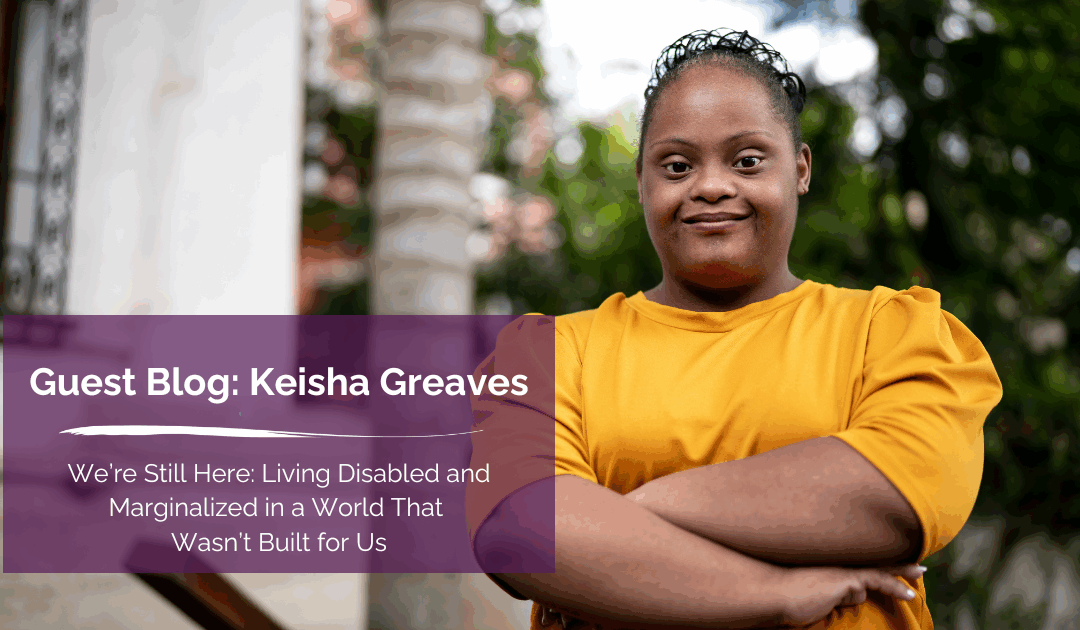
Keisha Greaves is the founder of Girls Chronically Rock, an adaptive fashion consultant, and a self-advocate. In a new blog series, Keisha will share her story, as well as her perspective on key issues for the disability community. In this entry, Keisha writes about the challenges of living at the intersection of disability and another marginalized identity, as well as the steps that must be taken to create a more inclusive and equitable world.
“They see my cane, not my culture.”
Those are the words of Jada, a 32-year-old Black woman living with lupus.
“I use a cane, sometimes a rollator. And I can tell you, the moment I walk into a doctor’s office, I know what I’m about to deal with. They see the cane. Maybe the skin tone. But they don’t see me. They don’t see that I have a master’s degree, that I’m a business owner, that I’ve been managing my health longer than some of them have had a license. They talk around me. Use big words to sound smart. And when I push back or ask too many questions, suddenly I’m ‘difficult.’ But I’m not being difficult. I’m advocating. Because no one else will,” says Jada.
“People want me to be inspirational or invisible. Nothing in between.”
Those are the words of Ray, a trans man with cerebral palsy.
“If I had a dollar for every time someone told me I’m ‘brave,’ I could pay off my medical debt. I’m not trying to be your inspiration. I’m just trying to live my life. I’ve been told I’m ‘too loud,’ ‘too political,’ or ‘too much.’ But what people really mean is they’re not ready to deal with someone who doesn’t fit their idea of what disability should look like, neat, quiet, nonthreatening,” Ray says. “I show up in spaces and I’m not always welcomed. Some LGBTQ+ events aren’t wheelchair accessible. Some disability spaces don’t want to talk about pronouns or gender. It’s like I have to pick which parts of me I’m allowed to bring. I don’t have the luxury of choosing. I bring all of me. Because I don’t know how not to.”
The Weight of “Proving” We Belong
Living at the intersection of disability and any other marginalized identity means you’re constantly asked to explain yourself, sometimes out loud, often silently.
- “You don’t sound like you have a disability”
- “But you’re so pretty!”
- “Wow, you’re in a wheelchair and you’re queer?”
- “You must be so strong.”
It sounds like praise. But it’s not. It’s code for: You don’t fit the stereotype I expected. Now I have to rewrite what I think disability looks like, and that makes me uncomfortable. The pressure to always educate people, to always translate your experience, to always prove that you belong in the room, that’s the part no one talks about.
Racism, Ableism, and Survival Math
Let’s keep it real. Systems in the U.S. (and beyond) were not built to support folks like us. Being a disabled person of color in a country with a legacy of racist medicine, inaccessible infrastructure, underfunded schools, and systemic racism means every decision can feel like strategy:
- Can I trust this doctor?
- Will they believe I’m in pain?
- Will I be followed in this store?
- Can I bring my mobility aid and feel safe?
- Will I get profiled on public transit?
- If I speak up, will I be labeled aggressive?
This is survival math. Calculations we’re doing constantly. Exhausting mental gymnastics, just to be safe, just to be heard, just to be treated like a human being.
“They told me I was too queer for Black church, too disabled for Pride.”
That quote comes from Samira, a disabled queer Afro-Caribbean woman. She grew up in the church, came out in her 20s, and was later diagnosed with a chronic illness. She says it’s like being a triangle in a world made of circles, always trying to smooth out the corners just to be allowed in. The truth is, we lose people when we force them to “choose” between their identities. Some leave their communities. Some go silent. Some give up. Some don’t survive. This is what happens when we make people feel like there’s no space for all of them.
Why Even Our “Safe” Spaces Fail Us
A lot of spaces that are supposed to be inclusive, such as disability nonprofits, LGBTQ+ centers, progressive events, still miss the mark.
Sometimes it’s subtle. Like having stairs at an event about “equity.” Or not translating materials into other languages. Or centering white leadership without question. Sometimes it’s loud. Like being told “now isn’t the time” to talk about race. Or that disability justice is “too niche.” Or watching Black and Brown disabled folks get erased from campaigns unless there’s a donation involved. Representation doesn’t mean putting one Black or queer face on a flyer. It means building systems where those people have real power, real safety, and real voice.
“I’m not broken. I’m layered.”
This quote came from Jay, a disabled Latinx artist with a speech difference. Jay told me that most people assume disabled folks are broken. But that’s the wrong word. “I’m not broken,” he said. “I’m complex. I’m layered. I’m navigating more than you can see.” It stuck with me. We’re not here to be fixed. We’re not “brave” just for existing. We’re whole, even when the world treats us like fragments.
So What Do We Want?
We want more than awareness. We want action. We want care that sees the whole person. Not just their diagnosis. Not just their gender. Not just their passport or skin color. We want education that supports multilingual, neurodiverse, disabled students of all backgrounds. We want jobs that don’t ask us to hide ourselves. We want movements that understand we can’t untangle our disability from our race, our queerness, our class, or our culture. We want joy. Rest. Equity. Space to dream. And we want you to stop pretending this is “too complicated.” It’s not. It’s humanity.
Final Thoughts: “We’re Not New. We’ve Always Been Here.”
Disabled people who are also Black, Brown, queer, trans, immigrant, fat, and poor, have always existed. We’ve led revolutions, shaped art, raised families, built communities. We’ve done it all, even when the world refused to see us. So no, we’re not asking for the spotlight. We’re asking for recognition. For protection. For liberation. Because we’ve earned it. We’ve survived for it. And we’re still here!