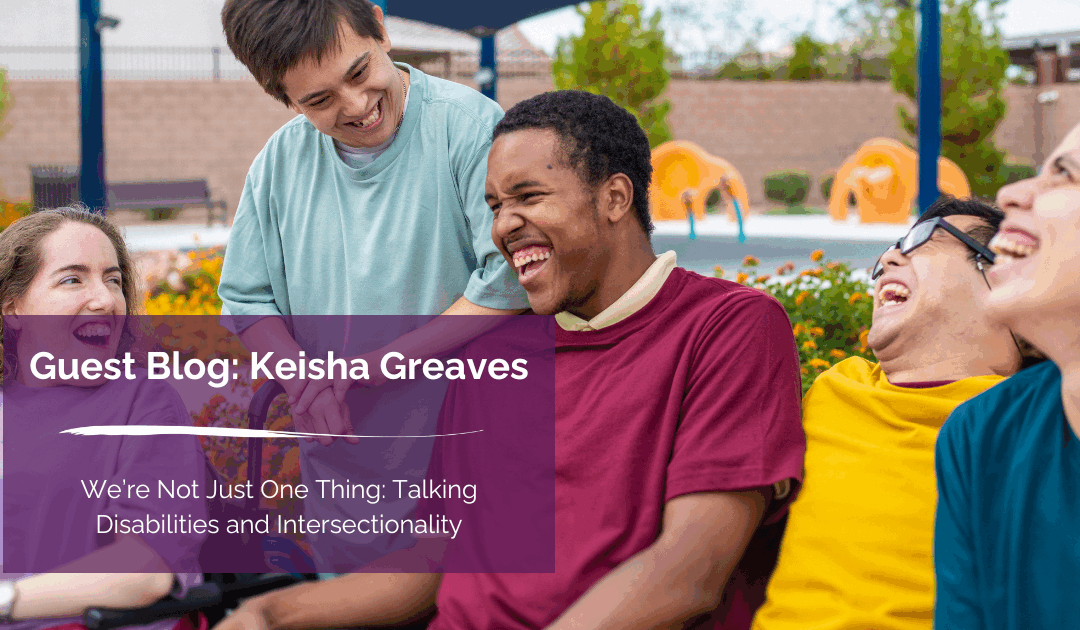
Keisha Greaves is the founder of Girls Chronically Rock, an adaptive fashion consultant, and a self-advocate. In a new blog series, Keisha will share her story, as well as her perspective on key issues for the disability community. In this entry, Keisha writes about intersectionality, and how advocates need to consider this in their work.
No one is just one thing. We all walk through this world carrying more than one layer of who we are. We’re not just a job title, a hometown, a medical diagnosis, or a box checked on a form. We’re a whole mix of experiences, cultures, beliefs, backgrounds, and, yes, identities. When we talk about disability, that truth doesn’t suddenly disappear. In fact, it becomes even more important to acknowledge. Too often, people try to shrink disability down to a single narrative, a story that fits neatly into the smallest possible box. But that approach erases the fullness of who disabled people really are. It makes us invisible in more ways than one. That’s where intersectionality comes in.
What is Intersectionality?
Let’s break it down in a way that makes sense.
Intersectionality is a word that might sound academic or abstract at first, but it’s really just a fancy way of saying this: different parts of our identities are constantly overlapping and interacting, and that affects the way we experience the world.
It was coined by legal scholar Kimberlé Crenshaw in 1989 to describe how Black women often face overlapping discrimination, not just because they’re Black, and not just because they’re women, but because they’re both. The discrimination they face is shaped by both of those identities at the same time, not in isolation. Now take that same idea and apply it to disability, and to race, gender, sexuality, class, age, religion, immigration status, and more. You start to see how layered things really are.
There’s No One Way to Be Disabled
A common misconception about disability is that it looks or feels the same for everyone. But disability isn’t a monolith. It shows up in all races, all genders, all income levels, all walks of life.
Think about it: a white man who uses a wheelchair is going to have a different experience navigating the world than a queer, Latina woman with a chronic illness. A non-binary Black person with a mental health condition may face barriers that someone else doesn’t even notice. And an immigrant parent with a visual impairment? They’re navigating systems in an entirely different way. All of these people are disabled. But the way disability shows up in their lives is deeply shaped by the other parts of who they are.
When Systems Overlap, So Do the Challenges
Let’s be honest, systems weren’t built with intersectionality in mind. Healthcare, education, employment, housing, and even transportation often work off one-size-fits-all models. That creates gaps, sometimes chasms, for people with multiple marginalized identities.
For example:
- Healthcare: Disabled people of color are more likely to be misdiagnosed or not taken seriously by doctors. Add in language barriers, lack of insurance, or medical racism, and you’re looking at a dangerous mix.
- Education: Black and brown disabled students are disciplined more harshly, segregated into separate programs, or written off entirely in school systems that fail to support.
- Employment: Disabled workers already face discrimination, but those who are LGBTQIA+, immigrants, or women often have to fight even harder just to be seen as capable.
- Law enforcement: A person with a developmental disability who is also Black is at a higher risk of being misunderstood, or harmed, by police. These aren’t just numbers; these are lives.
These overlapping experiences aren’t just statistics, they’re real, and they shape everything from how people access basic services to how they’re treated in public spaces.
You Can’t Choose Which Identity Comes First
One of the hardest things to deal with when living at the intersection of multiple identities is the pressure to “pick one.” People expect you to show up in a space as either disabled or Black, either LGBTQIA+ or Muslim, as if one identity cancels the other out. But that’s not how people work. You can’t wake up and say, “Today, I’ll just be disabled. Tomorrow, I’ll be queer. Friday, I’ll be a person of color.” It all moves together. Always. That’s why intersectionality matters. It pushes us to stop treating people like they’re puzzles made of separate pieces and start understanding that all those pieces are connected.
The Disability Community Needs to Do Better, Too
Even within the disability community, intersectionality isn’t always embraced the way it should be. A lot of mainstream disability conversations still center white, cisgender, heterosexual perspectives, especially those of people with physical disabilities.
That means people with intellectual disabilities, mental health conditions, or invisible disabilities often feel left out. So do disabled people of color, immigrants, queer folks, non-native English speakers, and so many others.
It’s not enough to say, “We all have a disability, so we’re in this together.” That sounds nice, but it ignores the reality that people experience ableism and racism and transphobia and classism, sometimes all in one day.
If we really want to build a disability community that’s inclusive and supportive, we have to be willing to listen, learn, and make space for people whose experiences are different from our own.
Representation Matters, and Not Just One Kind
When you don’t see yourself represented, it’s easy to feel like your story doesn’t matter. That’s why intersectional representation in media, policy, healthcare, and leadership isn’t just “nice to have.” It’s essential.
We need more stories about disabled people of color leading advocacy movements. More books by queer disabled authors. More films featuring disabled immigrants. More decision-makers with lived experience from multiple identities, not just one. Because when we see those stories, we realize we’re not alone. And when others see them, it broadens their understanding of what disability looks like.
Pause and Reflect
If you’ve made it this far, take a second to think about your own life or the people around you.
- Who are the disabled people in your life?
- What else do you know about them beyond their diagnosis or condition?
- How do their identities shape their experience of the world, and how people treat them?
This isn’t about guilt or shame. It’s about awareness. It’s about choosing to see people more fully.
Disability Activism: Not One-Size-Fits-All
Let’s talk about disability advocacy for a second.
It’s easy to think of activism as loud rallies, big speeches, or viral campaigns. And yes, those moments matter. But real, sustainable advocacy, the kind that actually creates change, requires us to show up in ways that reflect the whole person. For example, let’s say someone is fighting for better public transportation in their city. That might seem like a straightforward disability issue, right? But look a little deeper. A disabled Black woman may be fighting for accessible transit not just because of her wheelchair, but because she’s also a single mother, commuting to work in a part of the city with historically fewer resources. Her concerns may not just be ramps and elevators; they may also be about safety, affordability, and timing, because her job doesn’t offer flexibility and her childcare closes at a certain hour. Now, take a disabled undocumented immigrant. For them, “accessible transportation” might also involve fear of law enforcement presence at train stations, language barriers with bus drivers, and limited access to IDs required for transit passes. You see where this is going? The same issue can carry drastically different stakes for people depending on all of who they are.
That’s why activism rooted in intersectionality is so critical. Without it, we risk creating movements that only serve a narrow slice of the community, and leave everyone else behind.
Caregiving at the Intersections
Here’s something we don’t talk about nearly enough: how complex caregiving becomes when multiple identities are in play.
Caregiving is already hard. It’s physical, emotional, often unpaid or underpaid labor. But when a disabled person also belongs to a racial, religious, or gender minority, caregiving isn’t just about helping with a task, it’s about understanding the context of that person’s life.
Imagine a disabled person from a cultural background where disability is stigmatized or misunderstood. Their caregiver might need to navigate family dynamics, privacy concerns, or community shame on top of daily tasks. Now add queerness, language differences, or trauma history into the mix. You’re not just helping someone bathe or get dressed, you’re supporting someone through a world that often refuses to see them clearly.
And let’s not forget about who the caregivers are. Many caregivers, especially family members are women of color. They’re juggling racism, sexism, economic hardship, and their own mental and physical health. So, when policies ignore those realities, caregivers are left holding a bag that was never meant to be carried alone.
Intersectionality reminds us that caregiving isn’t a checkbox. It’s a relationship shaped by culture, identity, and power dynamics. And if we’re not taking all of that into account, we’re doing it wrong.
Community Isn’t Real Unless It’s Inclusive
Let’s get into this idea of “community.” It sounds lovely, right? A safe space. A group of people who “get it.” Somewhere to belong. But let’s tell the truth: many people within the disability community still feel excluded from “mainstream” disability spaces.
Why?
Because race matters. Language access matters. Class matters. Whether or not your disability is visible matters. Whether your identity is affirmed, your gender, your sexuality, your culture that matters. It’s one thing to say, “everyone’s welcome.” It’s another to show it by making your events accessible in multiple languages, having BIPOC (Black, Indigenous, and People of Color) leadership, offering gender-neutral restrooms, recognizing cultural holidays, and paying attention to who’s at the table, and who’s missing.
If your community space doesn’t make space for all kinds of disabled people, then it’s not a true community. It’s a club. And intersectionality doesn’t belong in clubs, it belongs in every room where decisions are being made.
The Danger of Single Stories
We’ve all seen it: the feel-good disability story that goes viral. The athlete who “overcame” the odds. The student who beat the diagnosis and graduated against all expectations. These stories are inspiring, sure. But they’re also…limited.
They don’t tell us about the disabled person who couldn’t graduate because they were homeless. Or the one who didn’t “overcome” anything but still deserves dignity and love. Or the one who’s navigating disability and systemic racism and trauma and can’t put on a smile today.
Intersectionality helps us remember that stories aren’t just about who succeeds in spite of their identity, but also about who’s being failed because of it. We need more space for complex stories. Messy stories. Real stories. The ones that don’t get shared on corporate commercials or fundraising brochures, but reflect the actual lives of the people we claim to support.
Building a More Inclusive World: It Starts with Listening
So, how do we take all of this and actually apply it? How do we make intersectionality more than just a buzzword?
Here’s a start:
- Listen more than you talk if someone is sharing their experience, don’t rush to respond or relate. Just listen. Especially if their identity is different from yours.
- Don’t assume. You don’t know what someone’s navigating just by looking at them or even by knowing their diagnosis. Ask. Be curious. Be humble.
- Pass the baton. If you’re in a leadership role, whether it’s at work, in an organization, or online, ask yourself whose voices you’re centering. Make room for others.
- Learn Intersectionality isn’t something you “arrive at.” It’s ongoing.
- Read books. Watch documentaries. Follow creators from different backgrounds. Be willing to be uncomfortable.
- Push back on tokenism. Representation matters, but it shouldn’t stop at one hire, one speaker, or one Inclusion means deep, systemic change, not surface level diversity.
And most importantly?
Show up. Whether it’s voting, donating, calling out discrimination, or supporting inclusive events, let your actions match your values.